The Yamuna's east bank sees a fraction of Agra's foot traffic, and the tomb standing on it was finished before the Taj Mahal was begun. Walk through the gate of the Tomb of I'timad-ud-Daulah, on the east bank of the Yamuna, on a weekday morning and you can have the marble platform more or less to yourself: no metered turnstiles, no bag-search queue, just a small, densely inlaid building sitting in a walled Mughal garden. It is the first Mughal structure faced entirely in white marble, and once you have looked at it properly the Taj across the river reads differently.

What you are actually looking at
Everyone calls it the Baby Taj, which is useful shorthand and slightly misleading. The empress Nur Jahan commissioned it for her father, Mirza Ghiyas Beg, a Persian-born nobleman who rose to be Jahangir's chief minister and carried the title I'timad-ud-Daulah, pillar of the state. Construction ran from 1622 to 1628, so the building was complete before Shah Jahan started work on the Taj Mahal for Ghiyas Beg's granddaughter, Mumtaz Mahal. The family line matters: this is the mausoleum of the Taj's great-grandfather figure, paid for by the woman who was effectively running the court.
Architecturally it sits between two eras. Mughal tombs before it were red sandstone with marble used as trim. This one is faced entirely in white marble, and it is the first building to use pietra dura, hardstone inlay, at any real scale: cornelian, jasper, onyx, lapis and topaz cut to fit channels in the stone and polished flush, laid out as wine flasks, cypress trees, vases and fruit. Nothing about it is monumental. It has roughly the footprint of a large house, raised on a low platform, with four squat octagonal minarets, chhatris above them, and a square pavilion where you expect a dome. It reads as an enlarged jewellery box rather than a shrunken monument.
What the visit involves and how long it takes
You come in through a gateway into a chahar bagh, a four-quarter garden split by water channels, with the tomb at the centre rather than at the far end. The walk down the axis is short, and it is the best view you will get of the whole composition, so take it slowly before you climb. On the platform, get close. The inlay only resolves at arm's length, and you can feel the difference between carved relief and set stone with a fingertip on the border panels.
The main chamber holds the cenotaphs of Ghiyas Beg and his wife Asmat Begum. Inside, the decoration switches from stone to painted and inlaid plaster, with Persian motifs on the walls and ceiling, and the light comes through perforated marble screens, jaalis, which throw moving patterns across the floor through the middle of the day. A narrow stair climbs to the upper pavilion. Walk round to the river side afterwards: a second gateway faces the Yamuna, and from that edge you get the flat, wide, bird-heavy stretch of water that the Mughal court actually travelled on.
Most people need 45 to 75 minutes. Give it 90 if you care about the inlay or you are photographing, and about 25 if you are honestly just ticking it off, which is the wrong reason to come. It is a single building in a garden, not a complex, and it does not reward a rushed loop.
Tickets at the gate and what a guided day adds
This is an Archaeological Survey of India monument and you buy at the window. The ticket is ₹310 for foreign nationals, dropping to ₹300 on Fridays, and ₹30 for Indian, SAARC and BIMSTEC nationals, with a small additional ADA charge on top. Under-15s go free. A video camera is ₹25 extra; still cameras and phones are not charged. Carry small notes: the window takes cash without fuss, and depending on the day you may or may not get a card or UPI option.
A guided option exists if you would rather be driven. Private full-day itineraries that include this tomb start from 37 USD per person, and reviews for the top-rated one are landing at about 1.7 a day, so it is being booked steadily rather than sitting idle. Those guided days run six days a week (Monday, Tuesday, Wednesday, Thursday, Saturday and Sunday), so Friday is the day you organise yourself, which happens to be the day the Baby Taj is most worth your time. Licensed guides also work inside the monument, and 20 minutes with one genuinely helps here, because almost everything interesting about this building is technical.
Queues, coaches and the space to stand
There is no group cap and no metered-gate system, so entry is a window, a quick look in your bag and you are through. Coaches and taxis drop on the main road approach, a short walk from the gate. Even when two tour groups overlap, the garden absorbs them; there is far more space per visitor than anywhere on the Taj side of the river, and that is the reason to come rather than any claim about obscurity. If you want it genuinely quiet, be at the window when it opens or arrive in the last hour of the afternoon.
Rules, access and what to carry
Standard ASI conditions apply: carry photo ID, keep your bag small, no drones, no tripods without written permission. Shoes come off or go into covers before you step onto the marble platform, so socks are worth having in hot weather, because the stone gets fierce by midday from April onwards. There is shade in the garden but very little on the platform itself, and no café inside; bring water.
On mobility: the garden paths are broad and essentially flat, so a wheelchair or a slow walker can reach the base of the tomb and see the whole façade. The platform is a short flight of steps up, and the stair to the upper pavilion is narrow and steep, so the interior is not step-free. Nobody will hurry you. Toilets are basic and near the entrance.
The three buildings that make this one make sense
The Baby Taj is a prototype, and a prototype only lands if you see what came before and after. For the before, go to Akbar's Tomb in Sikandra, 10 km north-west: a huge walled site, easy coach parking, and a tomb built in red sandstone with marble as decoration rather than skin. Entry is ₹310 for foreign nationals, ₹300 on Fridays, ₹30 for Indian nationals plus a small ADA charge, sunrise to sunset daily. It is the most instructive single comparison in the city, because the switch of material is the whole story.
A kilometre from it is the Tomb of Mariam-uz-Zamani, also in Sikandra, built 1623 to 1627: the same decade, the same patron family, radically cheaper materials. It is very quiet, has almost no infrastructure, and is usually empty on weekdays, which makes it a good small-group stop and a poor one for a coach. Entry is ₹300 for foreign nationals, ₹25 for Indian, SAARC and BIMSTEC nationals, free under 15.

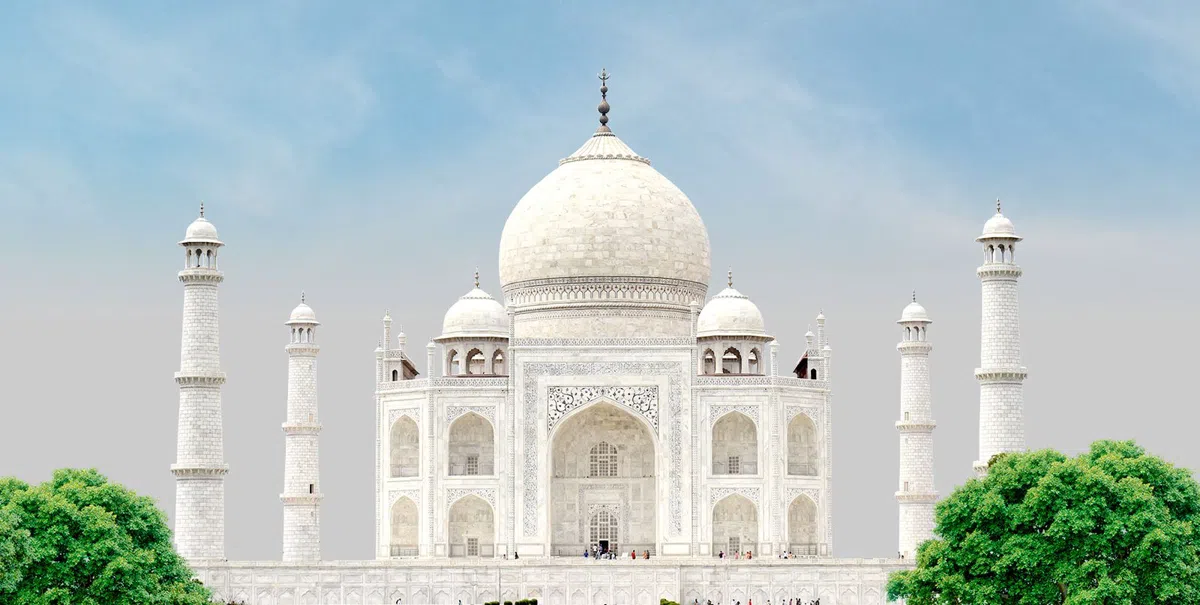
Then the after. The Taj Mahal in Taj Ganj, on the west bank, is the version with an empire's budget behind it: ₹1,100 for foreign nationals, ₹540 for SAARC and BIMSTEC, ₹50 for Indian nationals plus the ADA charge, with ₹200 more to enter the mausoleum chamber, and it is closed on Fridays. Entry is through screened gates with a strict small-bag rule and licensed guides only. See the prototype first and the masterpiece second if you can; the order changes what you notice. While you hold a Taj ticket, walk over to the Taj Museum in the Jal Mahal inside the Taj grounds, free with that ticket and open roughly 10:00 to 17:00, closed Fridays. Its inlay specimens and construction drawings are the clearest explanation in Agra of the pietra dura you will have been nose-to-stone with earlier, and the galleries are small enough that a group should split up.

Staying east for the sunset
Don't cross back too early. Mehtab Bagh, on the same east bank, is a ten-minute drive from the tomb and the one place where the Taj sits whole across the water in evening light. Entry is ₹300 for foreign nationals and ₹25 for Indian, SAARC and BIMSTEC nationals, plus an ADA charge of ₹200 and ₹50 respectively, open sunrise to sunset. It handles coaches and has a long riverfront terrace, but arrive 45 minutes before sunset: the colour on the dome goes fast and the best vantage points along the bank fill up first. Tomb in the morning, something in Sikandra at midday, Mehtab Bagh at dusk is the cleanest east-bank day in the city.

The pairing on a non-Friday
About 4 km away on the opposite bank, Agra Fort by Amar Singh Gate is the natural other half of this story, since the river-facing marble pavilions there were built by the same Nur Jahan-era court that commissioned her father's tomb. It is ₹650 for foreign nationals, ₹600 on Fridays, ₹50 for Indian nationals plus a ₹50 ADA charge for foreigners, open sunrise to sunset daily. Single entry via Amar Singh Gate, carry ID, and note that army-occupied sections are closed, so the visit is shorter than the walls suggest.

One stop that is not about the Mughals
When you have had enough seventeenth century, Sheroes Hangout on Fatehabad Road is run by the Chhanv Foundation and staffed by survivors of acid attacks. There is no fixed menu price: you pay what you think the meal was worth, and the money goes to surgery and legal costs. It is a walk-in used to tour groups and volunteers, though message ahead if you are more than a handful of people. It is confirmed trading through 2026, and it is the one stop on an Agra day that is about the city as it is now.

Is it worth it
Yes, with a condition: it is worth it if you want to understand the Taj rather than only photograph it. For anyone interested in architecture, craft or Mughal history, this is the single highest-value ticket in Agra, a few hundred rupees for the building where the technique was invented, with room to stand and look. It suits couples, solo travellers, photographers and anyone travelling with children who will not tolerate a two-hour queue. It also works well for groups, because the garden spreads people out and there is no cap at the door.
It is not worth it if you have one morning in the city and the Taj Mahal is still unseen; go there first. And if you want scale and spectacle, this is the wrong building: the pleasure is entirely in detail at close range.
Best time to go
Ticket windows open 30 minutes before sunrise and close 30 minutes before sunset, which gives you two good windows. Early is cool, almost empty, and the low light rakes across the inlay. The last 90 minutes of the afternoon warms the marble and is better for the garden as a whole. Avoid 11:00 to 15:00 from March to October, when the platform is hot underfoot and the light goes flat.
By day of the week: Friday is the best day of all, because the Taj Mahal is closed and most organised itineraries don't run, so Agra's monument traffic thins out, and the Friday ticket here is ₹10 cheaper. Weekends bring more domestic visitors; Monday to Thursday mornings are the quietest.
By season: November to February gives cool mornings, with occasional winter fog that can grey out a sunrise visit. In fog, go later and keep Mehtab Bagh for a clearer evening. March and April are warm and clear and reliable. May and June are genuinely punishing heat; if you are here then, take the sunrise slot and nothing else. The July to September monsoon brings fewer visitors, a high river, and the garden at its greenest, with rain usually arriving in short heavy bursts rather than all day. October is the quiet sweet spot.
Practical notes
Getting there. The tomb is on the east bank, 15 to 25 minutes by road from Taj Ganj depending on traffic and bridge queues. An auto or e-rickshaw from the Taj side is the normal way, for a small fare agreed before you set off; expect to negotiate. For a full east-bank day, hiring a car or auto for four to five hours is simpler and cheaper than three separate rides, and the driver will wait. Trains and long-distance buses arrive on the west side of the river, so plan the crossing into your morning rather than onto the end of it.
Cash. Bring rupees in small notes for tickets, ADA charges, shoe covers, water and the camera fee. Card acceptance at ASI windows is inconsistent, and the quiet sites in Sikandra are cash-only in practice.
Timing. Allow 60 to 90 minutes here, 60 more for Akbar's Tomb, 30 for Mariam-uz-Zamani, and be at Mehtab Bagh 45 minutes before sunset.
Budget. A foreign visitor doing the tomb, Mehtab Bagh and Akbar's Tomb pays roughly ₹1,400 in entry fees including ADA charges, plus transport; an Indian visitor pays well under ₹200. Add the Taj Mahal and the museum on a non-Friday and the foreign total rises by about ₹1,350 with the mausoleum chamber. A guided private day covering the same ground starts from 37 USD per person and removes all the haggling.
Where to sleep. Taj Ganj puts you closest to the Taj gates; Fatehabad Road has the larger hotels and more places to eat. Compare rates and locations with the Agra hotel search, and read the Agra guide for how the rest of the city fits around these monuments.