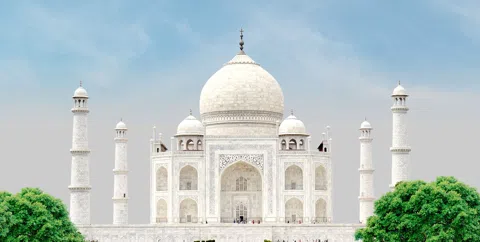
Spécial Agra
Agra's Quietest Taj View Is Across the River at Mehtab Bagh
The garden on the Yamuna's north bank faces the full north front of the Taj Mahal, and it is open on Fridays, when the monument itself is closed.

Par Matteo FerraroAgra is a Mughal city, not a single monument
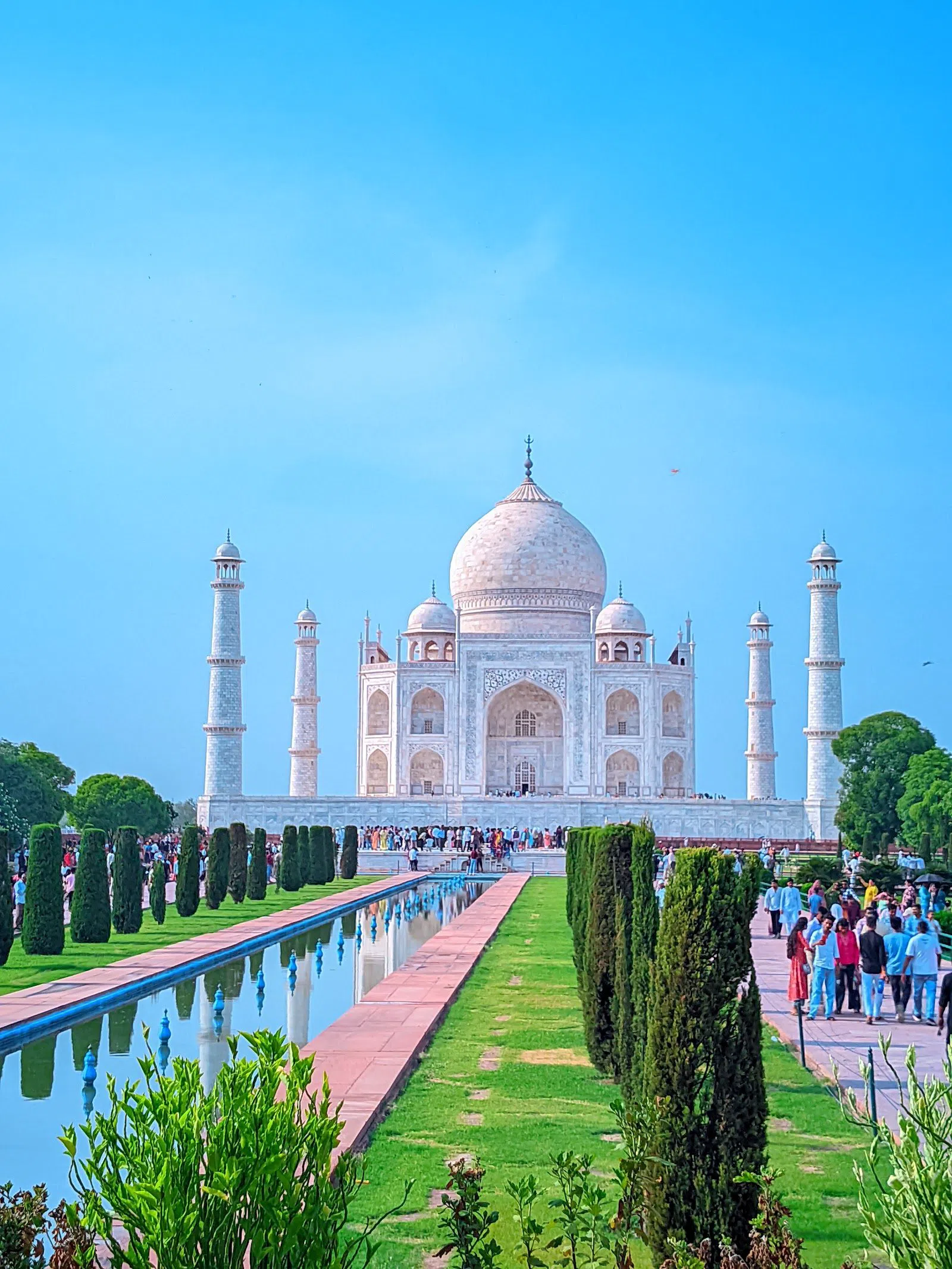
Entry to Mehtab Bagh (Moonlight Garden), on the Yamuna's north bank, is ₹25 for Indian nationals and ₹300 for foreign nationals, with under-15s free. The clipped lawns and red-sandstone water channels run down the floodplain to a large octagonal excavated tank, and the full north facade of the Taj Mahal stands directly across the water from it.


What you see from the garden
The plan is a square charbagh, with lawns divided by sandstone channels that point at the river. Walk the central axis to the octagonal tank at the far end, which is the only ticketed spot that frames the Taj head-on across the water.
Guides can come in with you, and there is no cap on party size. Coaches park on the approach road, so parties walk the last stretch in.
Préparez votre voyage à Agra
Prix en temps réel de nos partenaires de réservation.
Annulation gratuite sur de nombreuses chambres. Nous pouvons percevoir une commission lorsque vous réservez.
Walking in through Kachhpura village
Kachhpura village lies between the bridge and Mehtab Bagh, and its Mughal Heritage Walk strings Gyarah Sidi, Humayun's Mosque and the garden into one four-hour route. A local guide costs ₹850 per person, advance booking is expected, and the fee goes to the guides. The lanes are narrow brick, with mud-and-plaster houses on both sides, buffaloes tethered in doorways and women at the hand pumps. At the end of one lane the Taj's dome shows over the rooftops.


Gyarah Sidi is Humayun's ruined observatory, a few minutes' walk from the garden. A low flight of 11 worn stone steps descends into an open field toward hemispherical hollows cut into the ground, with Agra's skyline and the river beyond. The site is free, unstaffed and unsigned, so go with someone who knows the path.
Humayun's Mosque (Kachhpura Masjid) stands among the village houses and brick lanes on the same bank. It dates to around 1530, which makes it one of the earliest Mughal buildings standing anywhere, and it is squat and rectangular, with three low flat domes over a plain arched nave. Entry is free. It is a working mosque, so cover up, ask before you go in and keep away from prayer times.

North along the same bank
Chini ka Rauza is a short hop north of Mehtab Bagh on the same bank, and it is India's only Persian-style glazed-tile tomb. The weathered brick still carries patches of turquoise, cobalt and ochre glazing, and under the dome you can make out faded floral painting and Persian calligraphy. Much of the tilework has fallen away and structural repairs are ongoing, with scaffolding up at times. Entry is free and the site is rarely busy.


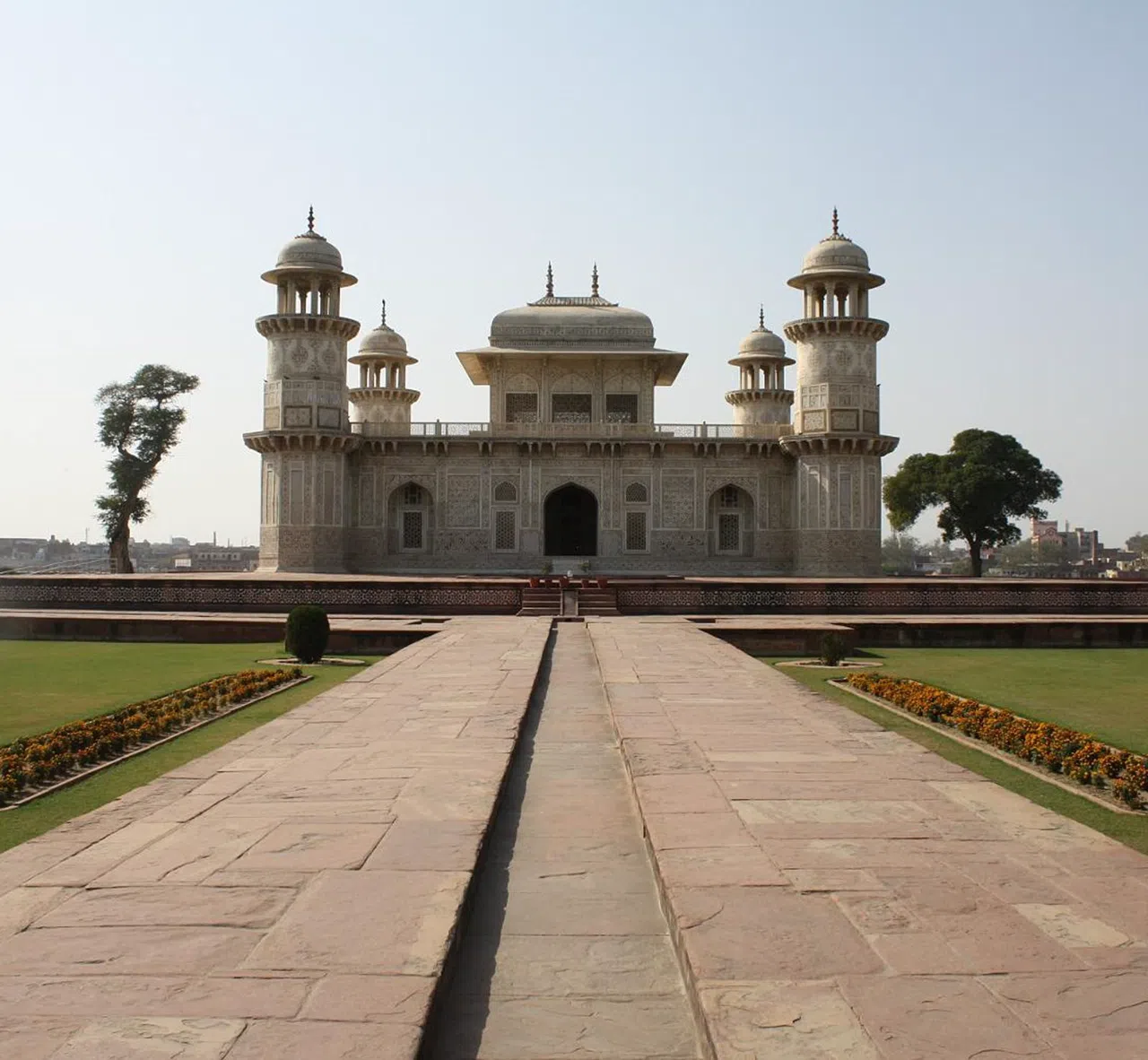
Tomb of Itimad-ud-Daulah (Baby Taj) is on the same side of the river as the garden, so the two fit into one morning. It was the first all-marble Mughal building and the first to use inlay heavily, and the Taj learned from it.
Entry is ₹30 for Indian nationals and ₹310 for foreign nationals. Foreign visitors also pay a ₹500 ADA toll, valid for several sites on the same day and waived on Fridays. The tomb is compact: four squat octagonal corner towers under domed kiosks, coloured pietra dura inlay over every surface, and a small walled charbagh around it.
Ram Bagh (Bagh-i-Gul Afshan) was laid out by Babur in 1526 and is the oldest surviving Mughal garden in India. It belongs to the same north-bank chain as Mehtab Bagh but has no Taj view, which is why it is empty most mornings. Entry is ₹25 for Indian nationals and ₹300 for foreign nationals. The terraces sit on stone plinths with open pavilions, deep sunken channels and cascade chutes, shaded by old mango and neem trees.

Seeing the Taj itself
Taj Mahal entry is ₹50 for Indian nationals and ₹1,300 for foreign nationals, and the mausoleum chamber costs ₹200 more. The marble stands on a raised plinth with four minarets, reflected down the central canal of its red-sandstone forecourt garden. Go inside on one day and come across the river on another. The gates are the pinch point, and that is where the queues form.
Night viewing runs five nights a month around the full moon, in batches of 50, and has to be booked ahead. It costs ₹510 for Indian nationals and ₹750 for foreign nationals.
Taj Museum is a small two-storey sandstone pavilion on the west side of the Taj garden, included with the monument ticket. It opens 9 a.m. to 5 p.m., shorter than the gate hours, and closes on Fridays with the rest of the site. The glass cases hold Mughal miniatures, celadon dishes, inlaid marble samples and the original building drawings. Those plans make the Mehtab Bagh excavations legible, and most visitors walk straight past.

Agra Fort on a Friday
Agra Fort opens 6 a.m. to 6 p.m. with no weekly closure, which makes it a good pairing with Mehtab Bagh. Entry is ₹50 for Indian nationals and ₹650 for foreign nationals, and both drop on Fridays, to ₹40 and ₹600. Under-15s go free, and licensed guides work the gate.

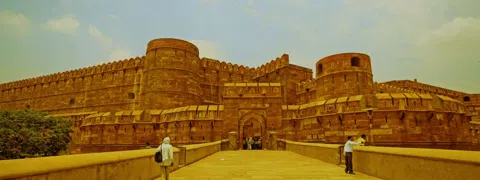
Allow two to three hours. You come in through massive red sandstone double walls and a curving ramp gateway, and the palace courtyards inside are white marble. The octagonal Musamman Burj looks downriver to the Taj and gives a third distinct angle on it.
Where else to stand on the city side
Dussehra Ghat is a five- to 10-minute walk from the Taj East Gate and gives the closest water-level view on the city side. Rough stone steps and a small Hanuman shrine sit on the south bank, with wooden boats drawn up on the mud and the Taj's rear wall and dome rising close over the water. Boat rides here are banned on security grounds, so treat any offer of one as unauthorised and stay on the steps. The bank is free and has no gate or staff, and it is unlit after dark.

Taj Khema Taj View Point is three minutes' walk from the Taj East Gate, a grassy mound in a state-run UP Tourism garden dotted with canvas tents and plastic chairs. Non-residents pay a small view-point charge (₹₹), and staff are relaxed about walk-ins. From the top of the rise the Taj's full silhouette clears the treeline, which makes this the easiest paid sunset viewpoint on the south side. Rooms at the hotel are booked online only.
Hotel Saniya Palace Inn rooftop restaurant (Taj Ganj) is a few minutes from the South Gate, a small potted-plant terrace of plastic chairs and chequered cloths where the dome and minarets fill the view over low concrete rooftops. Prices are ₹. The terrace seats a handful of people, so come up for breakfast and sleep elsewhere.

After the monuments shut

Qairo Rooftop Social Bar (Fatehabad Road) is a fourth-floor terrace with white parasols, cabanas and an upper deck, open until 12:30 a.m., by which time every monument has closed. Prices are ₹₹₹. It works as the end of a day that started with sunset at the garden. The Taj sits small and pale on the horizon beyond the city roofline, so come for the evening rather than the photograph. Tables are bookable, and weekends run DJ nights.
Sheroes Hangout (Taj Nagari) is run by acid-attack survivors, and profits fund surgery and legal aid. The café opens 10 a.m. to 7 p.m. daily, a bright painted room with hand-lettered walls, survivors' portraits and handicraft shelves. The menu board carries no prices; you pay what you think it is worth. Call ahead before you come. It is the one stop in Agra that is about the present.

Tickets at the gate or a tour booked ahead
Mehtab Bagh sells its tickets at the ASI counter by the gate, so the garden needs no advance plan. The village walk does, and Gyarah Sidi takes a guide to find at all.
Private sightseeing tours here run six days a week, Monday to Thursday and Saturday to Sunday, and they book up steadily, so reserve ahead if your dates are fixed.
Is it worth the crossing
It suits a visitor who already holds a Taj ticket for another day and wants the facade whole, with the river in front of it. The crossing to the north bank and the walk in through the village take a morning, and the garden gives you no detail on the marble.
Best time to go
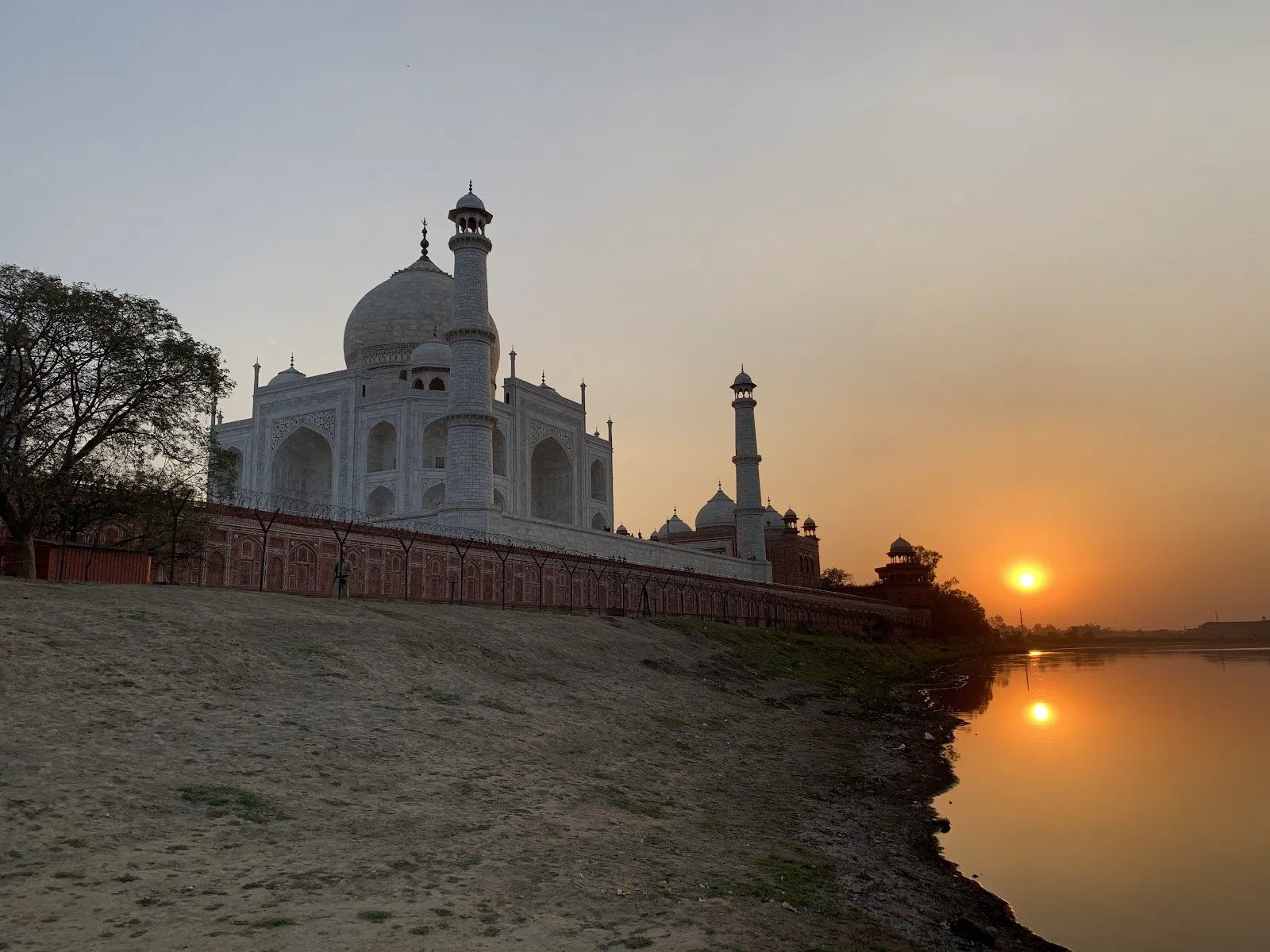
Come at sunrise, or in the last hour before the sunset gate-close. Those are the windows when the marble glows from across the water. Friday is the other timing to know, because the Taj Mahal is closed to visitors that day while Mehtab Bagh is open. When river haze flattens the view, the Taj Khema mound on the south side is the fallback.
Before you go
Fridays shut the Taj Mahal and its museum, while the north bank and Agra Fort stay open. Book the village walk and any night viewing ahead.
See the Agra guide and the Agra hotel search.
Avant de partir
Is Mehtab Bagh open on Fridays?
Yes. The garden is open on Fridays, when the Taj Mahal is closed to visitors. Agra Fort has no weekly closing day either, so the two pair well on a Friday.
How much does it cost to get into Mehtab Bagh?
₹25 for Indian nationals and ₹300 for foreign nationals, paid at the ASI counter at the gate. Under-15s go free, and there is no limit on party size.
Is sunrise or sunset better at Mehtab Bagh?
Both work. The marble takes the light best at sunrise and in the last hour before the sunset gate-close. If haze flattens the view, fall back to the Taj Khema mound on the south side, three minutes from the Taj East Gate.
Do I need a guide for Mehtab Bagh?
Not for the garden, where guides are allowed but tickets are sold at the gate. Gyarah Sidi, a few minutes' walk away, is an unsigned field, and you need a local guide to find it. The Kachhpura village walk links it with Humayun's Mosque and the garden in four hours for ₹850 per person, and you should book ahead.
Can I take a boat across the Yamuna to see the Taj?
No. Boat rides at Dussehra Ghat are banned on security grounds, so treat any offer of one as unauthorised and stay on the steps. The ghat is a five- to 10-minute walk from the Taj East Gate and is unlit after dark.